Pennsylvania lawmakers are looking to eliminate what they claim is a root cause of declining mental health and academic performance in schools: phone usage. On Feb. 3, 2026, a bill known as the “bell-to-bell” cellphone ban, Pennsylvania Senate Bill 1014, was passed in the PA Senate. Introduced by Senators Devlin Robinson, Vincent Hughes and Steve Santarsiero in Oct. 2025, the bipartisan legislation aims to restrict cellphone usage in all K-12 schools in Pennsylvania. If approved by the House Education Committee, access to cellphones for students would be banned from the first bell of the school day to the last—the reason it’s referred to as the “bell-to-bell” ban. A few exceptions are outlined by the bill: students with medical conditions, IEP students that require the use of a personal communication device, ESL learners who use cellphones for translation purposes and very limited instances for teachers who want to use cellphones as instructional tools with approval by the school principal.
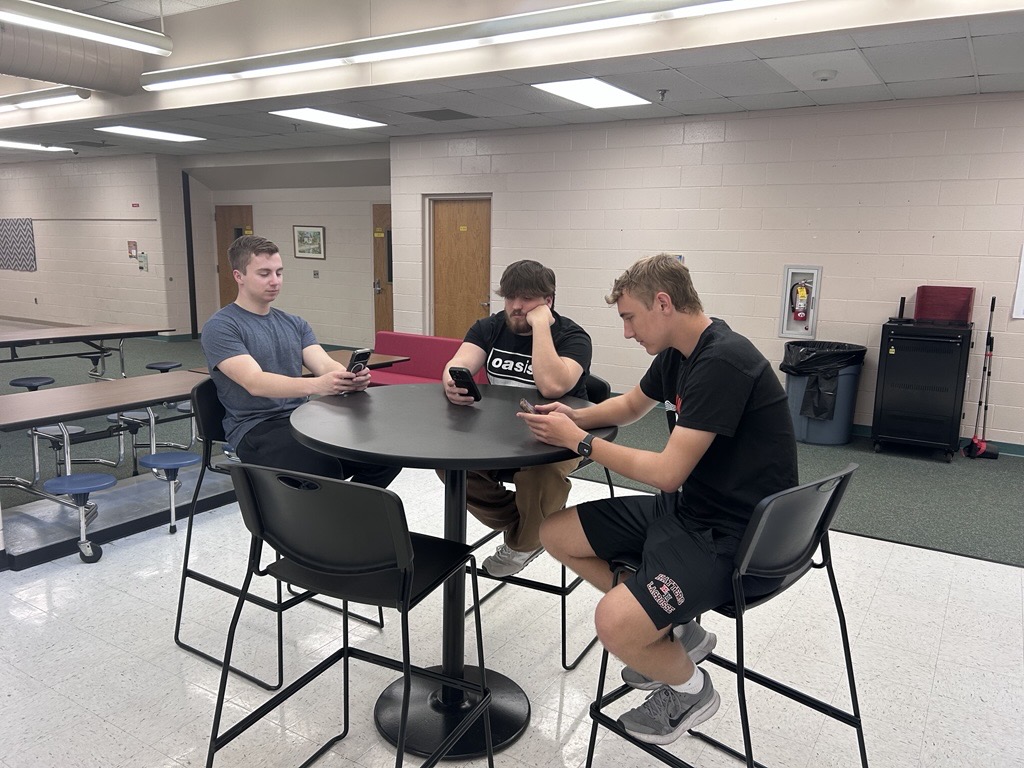
The Senators claim cellphones are the most harmful distraction in the classroom. HH English teacher Laura Hughes agrees that phones are a major distraction. She has noticed the downfalls of phones in the classroom, like a decrease in participation, an increase in cheating and a decrease in socialization. Hughes recognizes that when given a moment of downtime, students choose to grab their phones instead of speaking to one another. This is a saddening observation that speaks to the Senators’ claim that cellphone access is a major detriment to students’ social development.
As a parent herself, Hughes also addresses the concerns of many parents. Naturally, parents worry about their children’s safety while they are at school, so their child having a phone to contact them provides some relief. However, she adds that some parents agree that phones are a distraction and feel that their child or children would demonstrate better focus, resulting in higher academic achievement, from eliminating the distraction. Seeing the importance in both arguments made by parents, Hughes relates to these contradictory thoughts and feelings.
Could both sides find contentment? That would come down to how the policy is implemented in schools. If approved, the bill would require schools to enact a policy that would prohibit the use of phones by students during the entirety of the school day. But how would the policy be enforced? Would it be up to teachers to enforce the policy through storage in the classroom? Would it be up to administration to store phones in a secure location? How do these approaches affect the school budget? If allowed to keep phones on their person, would students be heavily supervised to ensure phones aren’t used?
These questions can’t be answered yet, but they are important to think about if a ban is required.
Hughes notes that it would take money to supply every classroom with pocket holders if that were to be the route taken. Additionally, collecting and retrieving phones would take time out of learning.
Moreover, effective enforcement would require significant monitoring. There’s not much doubt that constant supervision could contribute to a culture of distrust and stress. Senior Brooke Bell said she would feel that her sense of freedom would be stripped. She feels high-schoolers, especially seniors, should be treated as adults by being given the choice to act with the maturity, responsibility, and self-control towards their phones. Bell suggests that the school needs clear, consistent consequences enforced by teachers and staff for students misusing cellphones instead of taking phones away from everyone. She feels this could be a better start, as she notices inconsistencies between phone rules upheld by individual teachers — inconsistencies that hinder appropriate cellphone usage in classrooms. A ban, like this bill proposes, is a “cold-turkey” method that Bell feels would lead to backlash by students and possibly parents.
Bell presents another interesting point: if we teach students that they don’t have the ability to control themselves while having their phones on them by enforcing a ban, they will not have the opportunity to learn to exhibit self-control. She states that high school is a place to learn these types of rules about how to handle oneself and act appropriately in order to be prepared for the real world, where consequences may have a greater long-term impact.
Whether Senate Bill 1014 becomes law or not, the debate it sparks about trust, autonomy, and what students need to succeed goes beyond restrictive cell phone policy. In the case of this bill not being passed before the start of the 2026-2027 school year, Hatboro-Horsham plans to roll out its own policy to crack down on cell phone use.
“It is my belief, as well as the belief of many other Superintendents in the area, that this should be a locally decided issue and that each District and School Board needs to figure out what is best for their respective communities regarding cell phone use,” said Superintendent of Schools Dr. Scott Eveslage.
With this new policy, teachers will no longer have the discretion to allow students to use their devices during instructional time, but phone usage will still be permitted during lunch and learn and passing times. If the state passes Senate Bill 1014, however, this will override the school’s policy and be placed into effect.
The topic raises questions about how much control schools should exert, how much responsibility students should carry, and what habits schools should help students build. The answers to these questions, in accordance with the bill, define what learning should or will look like in future PA classrooms.